
Investment and Trading Opportunities and Risks on LBank in 2025
LBank has steadily strengthened its position among global cryptocurrency exchanges by focusing on accessibility, a wide range of digital assets, and competitive trading conditions. By 2025, the exchange has become a familiar choice for traders seeking exposure to both established cryptocurrencies and emerging tokens. However, alongside new opportunities come specific risks that require careful consideration.
Trading Opportunities Available on LBank
LBank offers access to a broad selection of cryptocurrencies, including major assets such as Bitcoin, Ethereum, and stablecoins, alongside a growing number of altcoins. This diversity allows traders to build balanced portfolios while also allocating a portion of capital to higher-volatility assets with short-term potential.
The exchange supports spot trading and futures contracts, enabling users to apply different strategies depending on market conditions. Futures trading on LBank includes adjustable leverage, which appeals to experienced traders who understand margin mechanics and risk exposure.
Another notable aspect is the frequent listing of new projects. Early access to newly launched tokens can create opportunities for short-term trading, particularly during periods of high initial liquidity and market attention.
Liquidity, Fees, and Execution Quality
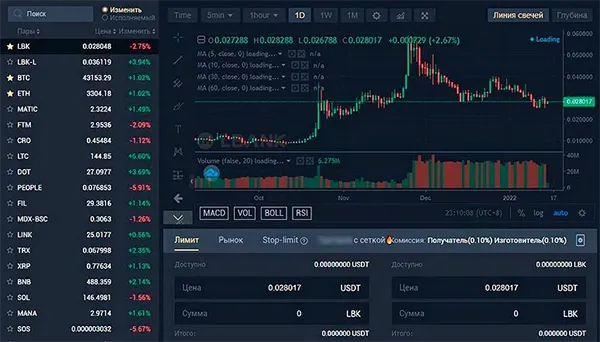
Liquidity on LBank has improved consistently due to increased user activity and expanded market coverage. Higher liquidity generally results in tighter spreads, which is particularly relevant for active traders executing multiple orders per session.
Trading fees remain competitive compared to other international exchanges. Maker and taker fees are clearly defined, allowing users to calculate costs in advance and optimise strategies based on volume and frequency.
Order execution is stable under normal market conditions, although during periods of extreme volatility slippage may still occur. This is a common characteristic across most cryptocurrency exchanges and should be factored into risk planning.
Investment Potential and Market Position
From an investment perspective, LBank benefits from its focus on expanding into emerging markets. By supporting multiple languages and regional payment options, the exchange continues to attract users beyond traditional crypto hubs.
The platform’s emphasis on early-stage token listings aligns with investor demand for growth-oriented assets. While this approach increases exposure to innovation, it also requires users to perform independent research before allocating funds.
LBank’s growth strategy relies on maintaining relevance in a competitive market rather than competing solely on brand recognition. This practical positioning has contributed to steady user acquisition rather than rapid but unstable expansion.
Security Measures and Asset Protection
Security remains a central concern for any exchange operating at scale. LBank employs standard protective measures such as cold storage for a significant share of client assets and multi-layer authentication for account access.
Internal risk controls are designed to monitor unusual trading activity and potential system vulnerabilities. While no exchange can eliminate risk entirely, these safeguards reduce exposure to common attack vectors.
Users are still advised to apply personal security practices, including strong passwords and external wallets for long-term holdings. Exchange-based storage is generally more suitable for active trading rather than passive investment.
Risks and Regulatory Considerations
Trading on LBank involves market risk driven by cryptocurrency volatility. Price fluctuations can be rapid and significant, particularly for newly listed or low-capitalisation assets.
Another factor is regulatory uncertainty. Cryptocurrency regulations continue to evolve in different jurisdictions, which may affect asset availability, trading conditions, or access for certain user groups.
Operational risks, such as temporary maintenance or liquidity constraints during peak market events, should also be considered when planning trading activity.
Risk Management and User Responsibility
Effective risk management on LBank depends largely on user discipline. Setting predefined entry and exit points helps limit emotional decision-making during volatile market phases.
Diversification across assets and avoiding excessive leverage are practical steps that reduce exposure to sudden market reversals. Futures trading, in particular, requires a clear understanding of margin requirements.
Ultimately, LBank provides tools and market access, but responsibility for capital allocation and risk tolerance remains with the user. A measured approach is essential for sustainable participation in crypto markets.