

Bullish Exchange in 2026: Liquidity, Fees and an Institutional Model Without Marketing Myths
By 2026, Bullish Exchange has settled into a clear position within the global crypto trading infrastructure. It is no longer framed as a bold newcomer backed by well-known investors, but as a functioning venue competing on liquidity depth, regulatory clarity and operational transparency. For professional traders, funds and corporate treasuries, the relevant questions are practical: how deep is the order book, how competitive are the fees, how robust is custody, and how “institutional” is the exchange beyond branding. This review examines Bullish Exchange in 2026 through those lenses, focusing on verifiable features rather than promotional narratives.
Market Structure and Liquidity Depth in 2026
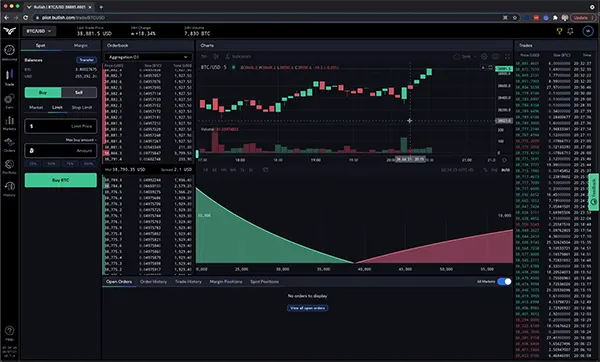
In 2026, Bullish Exchange operates as a regulated digital asset exchange headquartered in Gibraltar, with additional regulatory engagement in key jurisdictions where it offers services. Its core markets include BTC/USD, ETH/USD and selected high-cap altcoin pairs, alongside tokenised representations of certain real-world assets where permitted by law. Liquidity provision combines external market makers, internal matching engine efficiency and connectivity with large counterparties.
Average daily trading volumes fluctuate depending on macro conditions, but Bullish typically ranks within the second tier of global exchanges by spot volume. What matters more for institutional desks is not headline volume, but order book depth within a 10–50 basis point spread. In major pairs such as BTC/USD and ETH/USD, the visible depth in 2026 is generally sufficient for multi-million dollar orders to be executed with limited slippage under normal market conditions.
The exchange’s matching engine supports high throughput and low latency execution, with co-location options and API access tailored to professional users. FIX connectivity and advanced REST/WebSocket APIs allow algorithmic strategies to interact directly with the order book. During high-volatility events, spreads do widen, but Bullish has so far avoided the extended trading halts seen on some less mature venues.
How Bullish Manages Counterparty and Liquidity Risk
Following the exchange failures of 2022–2023, risk segregation became central to institutional due diligence. In 2026, Bullish maintains a model based on full reserve custody for client assets, with on-chain verification and third-party attestations published on a regular basis. While attestations are not equivalent to full financial audits, they provide transparency into asset backing.
Client assets are segregated from operational funds, and a significant portion of crypto holdings is kept in cold storage with multi-signature controls. Fiat custody is handled via regulated banking partners in established financial centres. This structure reduces direct counterparty exposure compared with exchanges that operate opaque treasury models.
On the liquidity side, Bullish works with professional market-making firms under contractual arrangements. These firms are subject to internal risk controls and margin requirements. Margin trading, where offered, is supported by real-time risk engines and automated liquidation protocols designed to limit systemic contagion in fast-moving markets.
Fee Structure and Cost Transparency
Fee competitiveness is a decisive factor for active traders. In 2026, Bullish applies a tiered maker–taker model for spot markets. Base fees for lower-volume accounts are broadly in line with industry averages, while higher tiers provide materially reduced rates for participants exceeding predefined 30-day volume thresholds.
For institutional clients and liquidity providers, bespoke agreements may apply, including rebates for adding liquidity. Unlike some offshore venues that advertise ultra-low fees but offset them with hidden costs, Bullish publishes its standard fee schedule clearly, including withdrawal fees and any charges related to custody or special services.
Derivatives, where available under regulatory constraints, carry separate fee schedules that reflect margin usage and funding rate mechanics. Funding rates on perpetual contracts are market-driven and transparently displayed. For cost-sensitive trading strategies, the effective fee after rebates and slippage is often more relevant than the nominal headline rate.
Hidden Costs: Slippage, Funding and Operational Frictions
Beyond posted fees, real trading costs include slippage, spread and funding payments. In liquid pairs, Bullish’s spread in normal market conditions is comparable to other regulated exchanges. However, during periods of extreme volatility, spreads can widen significantly, especially outside peak liquidity hours.
Funding rates on perpetual futures in 2026 tend to reflect broader market positioning rather than exchange-specific distortions. Bullish does not artificially suppress or inflate funding to attract flow, which means rates can be positive or negative depending on long–short imbalance. For leveraged traders, this cost can materially impact net returns over multi-day positions.
Operational frictions also matter. Fiat on-ramps and off-ramps may involve bank processing times and intermediary charges. While Bullish has improved its banking network by 2026, settlement times can still vary by region. Institutional desks often mitigate this by maintaining pre-funded balances rather than relying on just-in-time transfers.
What “Institutional Approach” Really Means in Practice
The term “institutional” is frequently used in crypto marketing, but on Bullish in 2026 it refers to specific infrastructure features. These include segregated accounts, role-based access controls, multi-user sub-accounts and detailed reporting suitable for compliance and audit requirements. Such tools are essential for funds, asset managers and corporate treasuries.
Compliance processes are aligned with international AML and KYC standards. Onboarding for institutional clients involves enhanced due diligence, beneficial ownership verification and source-of-funds checks. While this increases initial friction, it reduces regulatory uncertainty for professional participants operating in regulated environments.
Reporting capabilities include downloadable trade history, tax-relevant statements and API-based data feeds for portfolio management systems. For institutions subject to internal or external audits, the ability to reconcile on-chain transactions with exchange statements is a non-negotiable requirement.
Custody, Governance and Regulatory Positioning
By 2026, Bullish positions itself as a regulated venue rather than a lightly supervised offshore exchange. Its primary regulatory framework is rooted in Gibraltar’s Distributed Ledger Technology regime, complemented by compliance engagement in other jurisdictions where it serves clients. This provides a clearer legal perimeter than many competitors operating from loosely regulated territories.
Governance structures include a formal board, published corporate disclosures and separation between exchange operations and affiliated trading entities. While no exchange is entirely free from conflicts of interest, Bullish has taken visible steps to distance proprietary trading from client order flow, a concern raised repeatedly in earlier industry controversies.
Custody architecture combines cold storage, hardware security modules and strict internal access controls. For larger clients, additional safeguards such as whitelisted withdrawal addresses and time-locked withdrawals are available. These measures do not eliminate risk, but they significantly raise the barrier against internal misuse or external compromise.