

BloFin: A Derivatives Crypto Exchange Without Noise — Liquidity, Risk and Futures Trading in 2026
BloFin has positioned itself as a derivatives-focused crypto exchange built around clarity rather than marketing hype. In a market where many venues compete on features and incentives, BloFin focuses on execution quality, liquidity depth and structured risk management. As of 2026, traders are increasingly evaluating exchanges not by promotional campaigns but by reliability, transparency and infrastructure. This article examines how BloFin operates in practice, what makes its futures environment distinctive, and where the real risks lie when working with leveraged crypto instruments.
Core Structure of BloFin and Its Position in the Derivatives Market
BloFin operates primarily as a derivatives exchange, with a strong emphasis on perpetual futures contracts rather than spot trading. This strategic focus reflects broader trends in the crypto market, where derivatives volumes consistently exceed spot volumes. By concentrating resources on futures infrastructure, BloFin aims to deliver tighter spreads, stable order execution and predictable funding mechanisms.
One of the defining aspects of BloFin is its approach to liquidity aggregation. Instead of relying solely on internal order flow, the exchange integrates external liquidity sources and market-making partnerships. This allows it to maintain competitive depth across major trading pairs such as BTC/USDT and ETH/USDT, even during periods of high volatility. For traders, this translates into reduced slippage and more accurate entry and exit points.
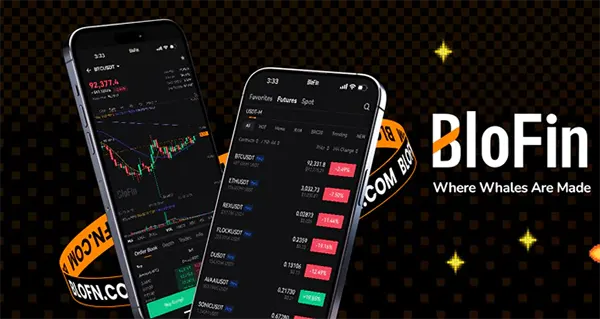
From a structural standpoint, BloFin also prioritises simplicity in its interface and trading flow. The platform avoids excessive feature layering, focusing instead on core tools such as order types, leverage settings and margin controls. This design choice reduces cognitive load, which is particularly relevant for derivatives trading where decision speed directly impacts outcomes.
How Liquidity and Order Execution Work in Practice
Liquidity on BloFin is maintained through a combination of internal matching engines and external market-maker support. The exchange uses a high-performance matching system designed to process large volumes of orders with minimal latency. In volatile conditions, this becomes critical, as delayed execution can significantly alter trade results.
Another important factor is the spread consistency across major pairs. On BloFin, spreads tend to remain stable even during moderate market swings, which suggests active liquidity management rather than passive order book reliance. This is particularly useful for short-term traders who depend on precision in entry levels.
Execution quality is also influenced by the exchange’s handling of large orders. BloFin supports partial fills and order slicing, allowing traders to execute bigger positions without dramatically impacting the market price. This feature becomes especially relevant for professional traders and funds managing higher volumes.
Risk Management and Leverage: What Traders Should Actually Watch
Leverage remains one of the most powerful and risky tools available on BloFin. Like most derivatives exchanges, it offers adjustable leverage levels that can amplify both gains and losses. In 2026, regulators and industry analysts continue to highlight leverage as the primary source of retail trading losses, making risk awareness essential.
BloFin implements a margin system that includes both isolated and cross margin modes. Isolated margin allows traders to limit risk to a single position, while cross margin uses the entire account balance as collateral. The choice between these modes directly affects liquidation thresholds and overall exposure.
The liquidation mechanism on BloFin is designed to protect both traders and the platform. When a position approaches its maintenance margin level, the system initiates liquidation procedures to prevent negative balances. However, rapid market movements can still lead to slippage during liquidation, meaning traders may lose more than expected if risk is not properly managed.
Common Risk Scenarios in Futures Trading on BloFin
One of the most common risks is over-leveraging. Traders often increase leverage to maximise potential returns without fully accounting for volatility. On BloFin, even relatively small price movements can trigger liquidation when high leverage is used, especially in volatile markets such as altcoins.
Another risk comes from funding rate fluctuations. Perpetual futures rely on funding payments between long and short positions to maintain price alignment with the spot market. Sudden changes in funding rates can significantly impact profitability, particularly for positions held over longer periods.
Finally, liquidity gaps during extreme market events can create unexpected outcomes. While BloFin maintains strong liquidity under normal conditions, sharp market crashes or spikes can still lead to temporary order book thinning. This increases the risk of slippage and affects both entry and exit efficiency.
Working with Futures on BloFin: Practical Trading Approach
Trading futures on BloFin requires a structured approach rather than reactive decision-making. The platform provides standard tools such as limit orders, market orders and stop orders, but their effectiveness depends on how they are used in combination. Traders who rely solely on market orders often face higher costs due to spread and slippage.
A more effective method involves combining limit orders with predefined risk parameters. Setting stop-loss and take-profit levels before entering a trade helps reduce emotional decision-making. BloFin supports these mechanisms directly within its interface, allowing for automated position management.
Position sizing is another critical factor. Instead of allocating large portions of capital to a single trade, experienced users typically divide their capital across multiple smaller positions. This approach reduces the impact of any single loss and improves overall portfolio stability.
Strategies That Align with BloFin’s Infrastructure
Short-term trading strategies such as scalping and intraday trading are well-suited to BloFin due to its stable execution and relatively tight spreads. These strategies rely on quick reactions and consistent order matching, both of which are supported by the exchange’s technical infrastructure.
Swing trading is also viable, particularly on major pairs with stable funding rates. Traders holding positions for several days need to monitor funding costs closely, as they can accumulate over time and reduce net profit.
More complex strategies, such as hedging spot positions with futures, are increasingly used by experienced traders. BloFin allows users to open opposing positions, which can help manage downside risk in volatile markets. However, this requires a clear understanding of correlation, funding rates and margin allocation.